

The FDA publishes a list of every AI-enabled medical device it has authorized. It is a useful and underread document. We pulled the full dataset and analyzed it: 1,614 authorizations, from the earliest entry in 1995 through to the most recent decisions in June 2026.
Some of what it shows is expected. Some of it is not. Taken together, it gives a clearer picture of what building an AI-enabled medical device actually involves than most commentary on the subject.
What the Dataset Is, and What It Is Not
The list covers devices where artificial intelligence or machine learning was identified as part of the authorization. That is a narrower thing than it sounds, and the distinction matters for reading the numbers honestly.
Plenty of medical devices contain sophisticated algorithms without appearing here, because the software was cleared as part of the device rather than characterized as AI-enabled. So the list is an accurate record of what has been authorized as AI, not a census of every device that computes something. We have been careful to describe it that way throughout.
Finding 1: AI Devices Are No Longer Exceptional
In 2015, the FDA authorized six AI-enabled devices. In 2025, it authorized 335. The first half of 2026 alone accounts for 181, which puts the year on pace to match or exceed the last.
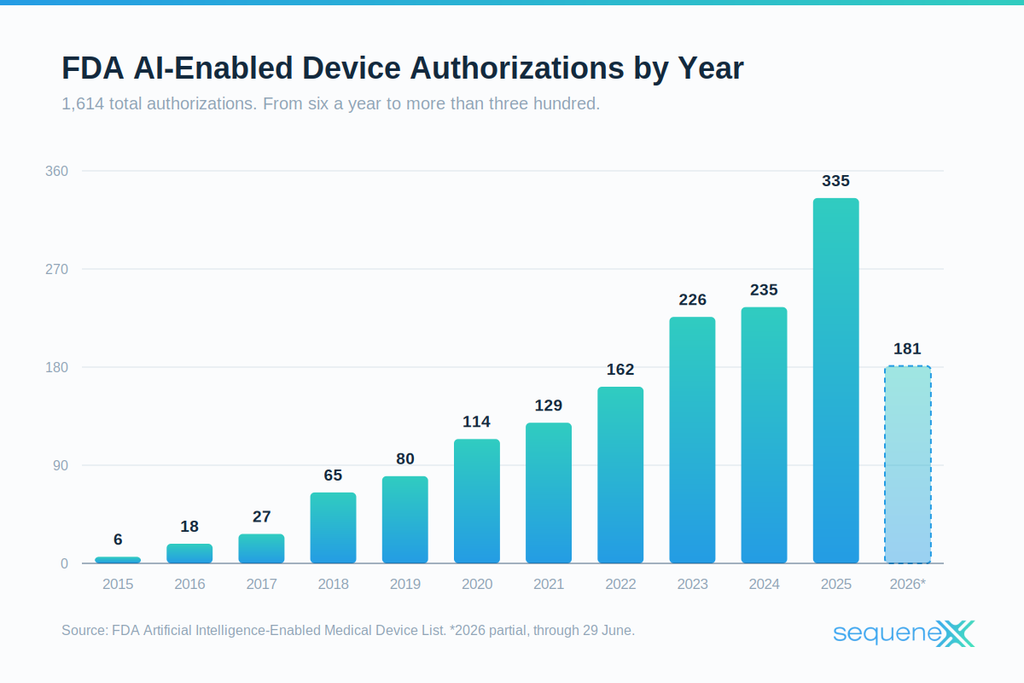
The shape of that curve matters more than any single number. AI in a medical device is no longer a novel regulatory proposition that needs special pleading. It is a well-populated category with hundreds of precedents, which changes the conversation a team has with a regulator and with an investor.
Finding 2: Almost Everything Clears Through 510(k)
This is the most practically useful finding in the dataset, and the one most likely to surprise teams who assume AI means an unusual pathway.
Pathway | Count | Share |
510(k) clearance | 1,553 | 96 percent |
De Novo | 40 | 2.5 percent |
PMA approval | 21 | 1.3 percent |
Ninety-six percent of AI-enabled devices reached market through 510(k), the predicate-based clearance route. Only a small minority required De Novo classification, which is what a genuinely novel device requires, and even fewer underwent PMA.
The implication is encouraging but conditional. The pathway is well-trodden, and for most AI-enabled devices, there is likely a precedent to reference. But a 510(k) still requires that the software be developed and documented to meet the expectations associated with the device’s classification, which is where the work actually sits. Our guide to SaMD regulatory pathways covers how those routes differ.
Finding 3: Radiology Is Three Quarters of Everything
Of 1,614 authorizations, 1,230 sit under the radiology panel. That is 76 percent. Cardiovascular is a distant second at 154, and no other specialty reaches 100.
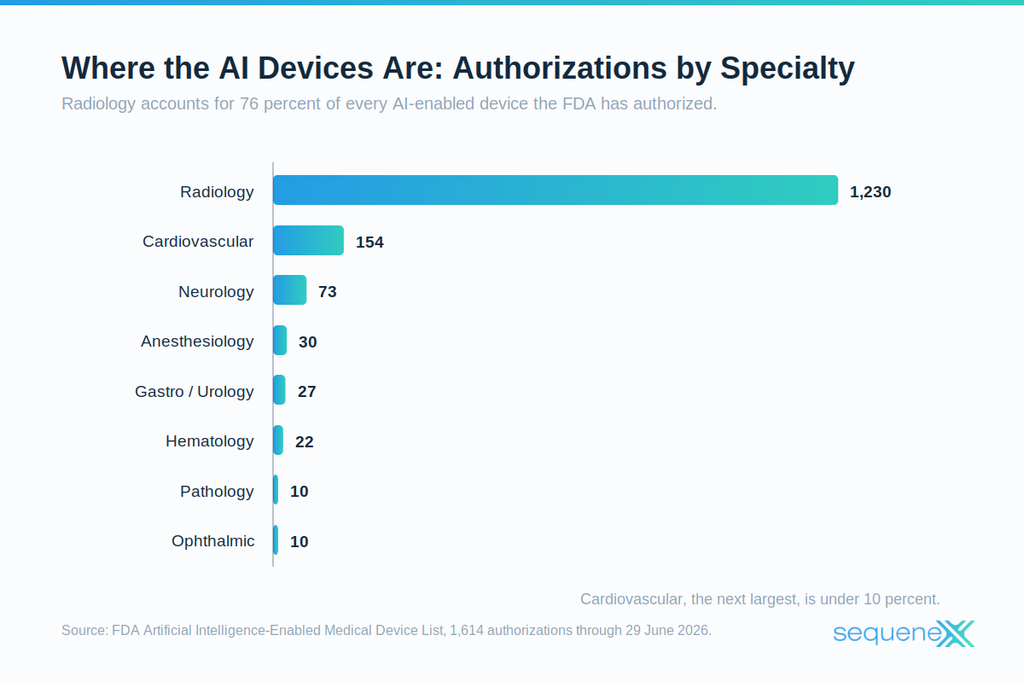
The concentration is not accidental. Imaging generates large volumes of standardized digital data, radiology workflows are already electronic, and the reimbursement landscape is relatively well established. Those three conditions are what AI needs, and few other specialties have all of them yet.
For anyone building outside imaging, that is worth understanding rather than lamenting. The absence of precedent in a specialty means fewer precedents to reference and a less familiar reviewer, both of which affect planning. It does not mean the pathway is closed.
Finding 4: AI-Native Companies Are Competing With the Largest Manufacturers
The top of the list looks predictable. Siemens Medical Solutions has 56 authorizations, Canon Medical Systems 42, Shanghai United Imaging 29. Large imaging manufacturers ship AI features with their systems, so high counts follow.
What is more interesting is who sits among them. Aidoc Medical has 30 authorizations, placing it third overall and ahead of most established device manufacturers. Hyperfine has 12, Viz.ai 10, Subtle Medical 9, Clarius Mobile Health 12.
None of those companies has a decades-long device manufacturing heritage. They built software, pursued clearance, and repeated the process. For a team weighing whether an AI-first medical device company can realistically reach market, the dataset answers that question with counted regulatory decisions rather than opinion.
Finding 5: The Connected Device Pattern Is Proven, in Cardiology
Within the dataset, there is a cluster that directly describes the connected-device model: a wearable or patch capturing a continuous physiological signal, with an algorithm interpreting it. Around twenty authorizations involve ECG and cardiac rhythm analysis, from companies including Anumana, iRhythm Technologies, Tempus AI, Medtronic, and Withings.
That is the template working end-to-end: sensor hardware, embedded software, an algorithm that interprets, and regulatory clearance that covers it. It is the same architecture behind any connected medical device platform, applied to a cardiac signal rather than a metabolic one.
A notable absence worth flagging carefully
Searching the dataset for glucose and diabetes devices returns four results, the most recent of which was authorized in July 2019. Over the past seven years, the overall list grew from 80 authorizations per year to 335.
We would caution against overreading that. As noted at the outset, this list records devices authorized as AI-enabled, and modern continuous glucose monitors perform substantial signal processing, with software that was cleared as part of the device rather than characterized as AI. The honest statement is that AI-enabled authorizations in metabolic care are rare and dated, not that algorithms are absent from the field.
What This Means for Teams Building One
Read together, the dataset says the regulatory route for AI-enabled devices is established, predominantly predicate-based, and open to companies without manufacturing heritage. What it does not say, because a list of authorizations never could, is how those devices were built.
Every one of the 1,614 required the same underlying work:
- A defined intended use, because that is what determines classification, and classification determines everything downstream.
- A software lifecycle with evidence, developed under IEC 62304 within a quality management system, with requirements, architecture, verification, and traceability that a reviewer can follow.
- Risk management connected to the software, under ISO 14971, with hazards traced to controls and controls traced to tests.
- Discipline specific to AI, including model version control, prespecified analysis, external validation, and a defined approach to how the model may change after release.
That last point is where AI-enabled devices differ most from conventional software. A model that learns or is retrained raises questions that a static algorithm does not, which is why predetermined change-control planning has become central to managing these devices over their lifetime. Our guide to developing AI-enabled medical devices covers that in depth.
Frequently Asked Questions
How many AI medical devices has the FDA authorized?
The FDA’s list of AI-enabled medical devices contains 1,614 authorizations as of 29 June 2026, dating back to the earliest entry in 1995. Growth has accelerated sharply, from six authorizations in 2015 to 335 in 2025.
What regulatory pathway do most AI medical devices use?
The large majority clear through 510(k). Of 1,614 authorizations, 1,553 were 510(k) clearances, 40 were De Novo classifications, and 21 were PMA approvals. AI does not automatically mean a novel or more demanding pathway.
Which medical specialty has the most AI devices?
Radiology, by a wide margin. It accounts for 1,230 of 1,614 authorizations, roughly 76 percent. Cardiovascular is second with 154, and no other panel exceeds 100.
Can a startup get an AI medical device cleared?
The dataset suggests yes. Several companies without long device manufacturing histories hold substantial numbers of authorizations, including Aidoc with 30, Hyperfine with 12, Viz.ai with 10, and Subtle Medical with nine. What they share is software built to medical device lifecycle expectations rather than retrofitted to them.
Building the Software Behind an AI-Enabled Device
The pathway is established. What determines whether a team walks it efficiently is whether the software and its supporting evidence were built together, or whether the evidence has to be reconstructed when a submission approaches.
Sequenex develops medical device software under an ISO 13485-certified quality management system, with lifecycle practices aligned to IEC 62304 and risk activities aligned to ISO 14971, across Software as a Medical Device, connected device platforms, and biosensor and CGM software. The sponsor retains responsibility for regulatory strategy, classification, and submissions. To discuss your device, get in touch.
