
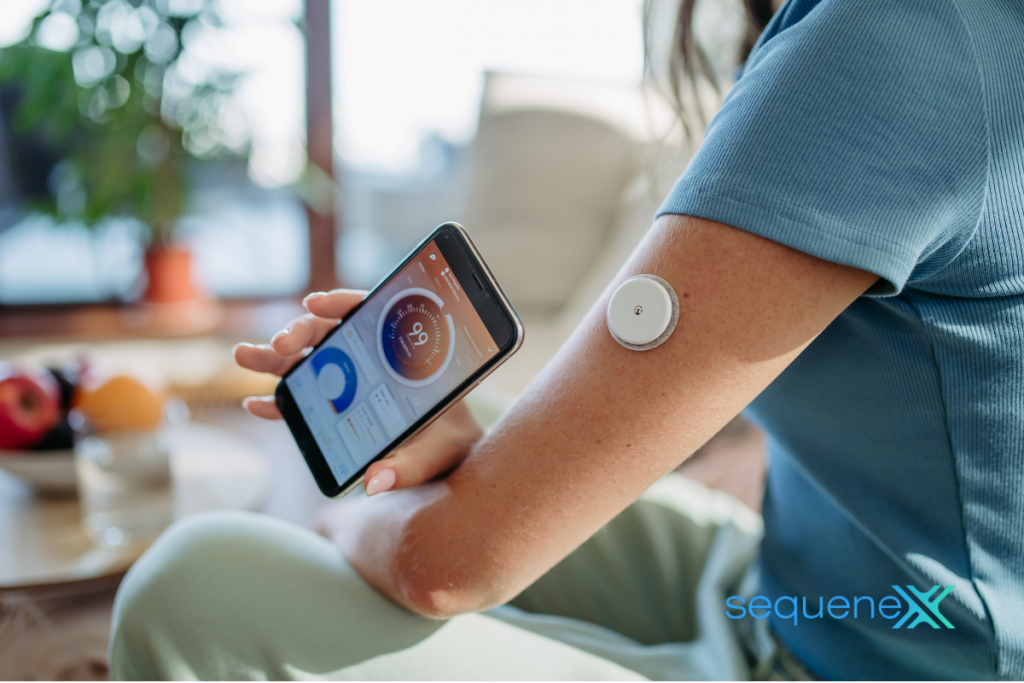
An iCGM (integrated continuous glucose monitoring system) is a CGM that the FDA has classified under 21 CFR 862.1355, allowing it to send reliable glucose data to other connected devices, such as insulin pumps and dosing algorithms. It is one of three interoperable diabetes device classifications FDA created between 2018 and 2019.
The other two are the ACE pump (alternate controller-enabled insulin pump), which accepts dosing commands from an external controller, and the iAGC (interoperable automated glycemic controller), the algorithm that calculates and sends those commands.
Each classification is Class II with special controls, which are the specific requirements a device must meet to reach the market through a 510(k). This guide explains what each one is, what special controls it requires, and which devices have been cleared under it.
The three classifications at a glance
iCGM | ACE pump | iAGC | |
|---|---|---|---|
What it is | A CGM that shares glucose data with connected devices | An insulin pump that accepts commands from a separate controller | Software that calculates insulin doses and commands a connected pump |
Regulation | |||
Main product code | QBJ | QFG | QJI |
First authorization | Dexcom G6, De Novo DEN170088, March 27, 2018 | Tandem t:slim X2, De Novo DEN180058, February 14, 2019 | Tandem Control-IQ, De Novo DEN190034, December 13, 2019 |
Core requirement | Accuracy across glucose ranges, proven with confidence bounds | Delivery accuracy and a validated interface | Clinical validation and use only with iCGMs and ACE pumps |
Each first authorization was a De Novo request, which created the classification. Every later device of the same type can use the faster 510(k) pathway. When FDA authorized the Dexcom G6, it said future iCGMs “can go through a more streamlined premarket review known as 510(k) clearance.” FDA said the same of ACE pumps in 2019.
FDA’s stated goal was choice. Compatible components give “patients the flexibility to tailor their diabetes management tools to best meet personal preferences,” FDA said in its 2018 announcement.
iCGM: integrated continuous glucose monitoring systems
An iCGM measures glucose continuously and is designed to reliably transmit its readings to other devices. Not every iCGM can drive insulin dosing; the FDA uses separate product codes to indicate what each sensor is cleared for.
Product code | What it covers | Examples |
|---|---|---|
QBJ | iCGM, factory calibrated | Dexcom G6, G7, and G7 15 Day; FreeStyle Libre 2 and 3 sensors cleared for AID use (March 2023) |
QLG | iCGM, factory calibrated, not for use with AID systems | Original FreeStyle Libre 2 (2020) and Libre 3 (2022) |
SAF | iCGM for non-intensive glucose monitoring, over-the-counter | Dexcom Stelo, Abbott Lingo, Signos |
SBH | iCGM for non-intensive glucose management, over-the-counter | Abbott FreeStyle Libre Rio |
Three other product codes sit under 862.1355, covering non-intensive diabetes management and professional use.
Not every CGM used with an AID system is an iCGM. Medtronic’s Simplera Sync sensor was approved through a PMA (P250012, August 2025) as a Class III sensor that is a component of an AID system. Senseonics’ implantable Eversense 365 (K241335, September 2024) is regulated under its own classification, 21 CFR 862.1357, for iCGMs with a sensor containing dexamethasone acetate.
iCGM accuracy requirements
The accuracy special controls are the heart of 21 CFR 862.1355. Each percentage below is a minimum for the lower one-sided 95% confidence bound of the share of readings that fall within the stated range of a reference value, not a simple average. That makes the bar higher than it looks: the study must be large and consistent enough that FDA can be confident the true performance clears the threshold.
Glucose range | Agreement with reference | Lower 95% confidence bound must exceed |
|---|---|---|
Below 70 mg/dL | Within 15 mg/dL | 85% |
70 to 180 mg/dL | Within 15% | 70% |
Above 180 mg/dL | Within 15% | 80% |
Below 70 mg/dL | Within 40 mg/dL | 98% |
70 to 180 mg/dL | Within 40% | 99% |
Above 180 mg/dL | Within 40% | 99% |
Entire measuring range | Within 20% | 87% |
The regulation also rules out the most dangerous errors outright:
- No reversed extremes. When the iCGM reads below 70 mg/dL, no matching reference value may be above 180 mg/dL. When it reads above 180 mg/dL, no matching reference value may be below 70 mg/dL.
- Trend direction. No more than 1% of iCGM readings may show glucose rising faster than 1 mg/dL per minute when it is actually falling faster than 2 mg/dL per minute, and the same limit applies in the reverse direction.
Other iCGM special controls
- Clinical study design. Use a traceable laboratory reference method and a study population and glucose range that represent the intended use. Show accuracy across the full wear period, with pediatric data comparable to adult data or an accepted justification.
- Data reliability. Avoid clinically significant gaps in data over the sensor’s life, and have a strategy for secure, reliable transmission of real-time readings to connected devices at clinically meaningful intervals.
- Product controls. Include manufacturing and release controls, testing for interfering substances such as medications, foods, and supplements, measures that prevent use beyond the claimed wear period, and a usability study.
- Labeling. Report accuracy separately for each population and insertion site, in ranges below 54, 54 to under 70, 70 to 180, over 180 to 250, and over 250 mg/dL. Also report rate-of-change accuracy, how often data gaps happen and how long they last, alert performance (true, false, missed, and correct alert rates), and observed sensor life.
For the sensor technology behind these numbers, see our guide to continuous glucose monitoring technology.
ACE pump: alternate controller enabled insulin pumps
An ACE pump is an insulin pump that can receive dosing commands from a separate, compatible controller, an algorithm from the same company or another, running on the pump, a phone, or another device. The pump must deliver insulin accurately and keep the user safe if the controller fails or the connection drops.
ACE pump special controls
The special controls in 21 CFR 880.5730 cover four areas:
- Delivery and safety performance.
- Delivery accuracy under foreseeable conditions, such as temperature, pressure, and the properties of the drug
- Occlusion and air-in-line detection
- Drug compatibility and stability, biocompatibility, reliability over the pump’s use life, and electrical, EMC, and wireless safety
- The interface.
- Validated interface specifications covering secure pairing, reliable transmission, sharing pump status (battery, reservoir, errors), and safe handling of out-of-bounds data
- A process for sharing the specification with partners and validating their use of it
- Safe failure.
- If communication with the controller is lost, the pump continues safe therapy, for example by reverting to a preprogrammed safe basal rate
- Critical event logs record deliveries, commands and confirmations, malfunctions, alarms and acknowledgments, and connectivity events
- Risk, human factors, and labeling.
- Risk controls with a traceability analysis and a human factors study
- Labeling that states compatible drugs and concentrations, basal and bolus ranges and increments, delivery accuracy, occlusion alarm performance, and wireless quality-of-service requirements
ACE pumps cleared in the US
ACE pump | Company | First ACE clearance |
|---|---|---|
t:slim X2 | Tandem Diabetes Care | DEN180058, February 2019 |
Omnipod DASH with interoperable technology | Insulet | K191679, September 2019 |
Omnipod 5 Pod | Insulet | K203768, January 2022 |
iLet ACE Pump | Beta Bionics | K223846, May 2023 |
Tandem Mobi | Tandem Diabetes Care | K223213, July 2023 |
DEKA ACE Pump System (twiist) | DEKA / Sequel Med Tech | K213536, July 2023 |
Accu-Chek Solo micropump with interoperable technology | Roche | K213134, August 2023 |
Inessa System | Triple Jump Israel | K230545, December 2023 |
embecta Insulin Delivery System | embecta | K234027, August 2024 |
MiniMed 780G pump | Medtronic (now MiniMed) | K251032, July 2025 |
Several pumps have later clearances for new versions, apps, or partner integrations. Clearance does not mean commercial launch: embecta cleared its patch pump in August 2024 and discontinued the program that November.
iAGC: interoperable automated glycemic controllers
An iAGC is the algorithm in an automated insulin delivery (AID) system. It reads glucose from an iCGM, calculates insulin doses, and sends commands to an ACE pump. Examples include Tandem’s Control-IQ, Insulet’s SmartAdjust, Tidepool Loop, Beta Bionics’ iLet algorithm, MiniMed’s SmartGuard, and Diabeloop’s DBLG2.
The iAGC special controls in 21 CFR 862.1356 require:
- Clinical validation in the intended population, with possible postmarket data collection
- A human factors study and a training plan
- Secure data transmission and specifications for the input, command, and host devices
- Safeguards when communication is interrupted, lost, or restored
- Interface specifications that include a safe software update mechanism, plus critical event records
- A postmarket responsibility plan agreed with the makers of connected devices, covering adverse event reporting, complaints, and investigations
- Device restrictions: glucose input only from iCGMs and commands only to ACE pumps, unless FDA accepts another device
- Labeling that addresses pediatric use and risks such as severe hypoglycemia and diabetic ketoacidosis
The same regulation includes a second product code, QJS, for controllers that suspend insulin only when a low is predicted. Tandem’s Basal-IQ (K193483, February 2020) is the only device cleared under it.
For which algorithms have been cleared, how adaptive algorithms are reviewed, and why FDA does not label them AI, see our guide to AI in diabetes devices.
How the three work together
In an AID system, the iCGM sends a glucose reading every few minutes. The iAGC uses it, along with recent insulin and other inputs, to calculate a dose. The ACE pump receives the command, delivers the insulin, and reports back. Because each part is cleared individually, one company’s algorithm can run on another company’s pump using a third company’s sensor.
That flexibility puts more weight on the connections. Two features of the special controls make interoperability work in practice:
- Interface specifications are shared. ACE pumps and iAGCs must have validated interface specifications and a process for sharing them with partners. Integration is built on documented interfaces, not one-off engineering.
- Responsibility is shared. The iAGC must have a postmarket plan agreed with the makers of the connected devices, so adverse events can be investigated across companies.
For the standards and data formats behind these connections, see our guide to diabetes device interoperability. For the companies building on this model, see our overview of the diabetes technology ecosystem.
Building to the special controls
For device makers, the special controls work as a ready-made set of design inputs. Map each one to a requirement, a verification activity, and a record in your design and development file.
- Requirements. Turn each special control into a testable requirement, such as accuracy thresholds, a safe basal rate on lost communication, or event log contents.
- Interface specification. Write and version the specification early, include pairing, status, error, and update behavior, and plan how partners will receive and validate it.
- Verification and validation. Size clinical studies to meet the confidence bounds, not just the point estimates, and test interfering substances and wear-period limits.
- Risk management. Trace each hazard, such as reversed extremes, missed lows, or lost commands, to a control and a test, in accordance with ISO 14971.
- Software lifecycle. Run pump, sensor app, and algorithm software through an IEC 62304 process, with cybersecurity built into pairing and transmission.
- Labeling. Plan the labeling tables the regulation requires, such as accuracy by range and alert performance, while the clinical study is being designed, so the study collects the data the label needs.
Frequently asked questions
What is an iCGM?
An iCGM (integrated continuous glucose monitoring system) is a CGM that the FDA has classified under 21 CFR 862.1355, allowing it to reliably send glucose readings to connected devices, such as insulin pumps and dosing algorithms. It must meet specific accuracy requirements across glucose ranges. The Dexcom G6 was the first, authorized in March 2018.
What are the iCGM special controls?
They are the requirements in 21 CFR 862.1355 that every iCGM must meet. They include accuracy thresholds across low, in-range, and high glucose levels, measured as lower 95% confidence bounds; limits on dangerous errors and wrong trend directions; clinical study design rules; secure and reliable data transmission; interfering-substance testing; and detailed labeling of accuracy and alert performance.
What is an ACE pump?
An alternate controller enabled (ACE) pump is an insulin pump that can accept dosing commands from a separate, compatible controller, such as an algorithm from another company. FDA regulates ACE pumps under 21 CFR 880.5730, product code QFG. The Tandem t:slim X2 was the first, authorized in February 2019.
What is an iAGC?
An interoperable automated glycemic controller (iAGC) is software that calculates insulin doses from iCGM data and other inputs and sends commands to an ACE pump. FDA regulates iAGCs under 21 CFR 862.1356, product code QJI. Tandem’s Control-IQ was the first, authorized in December 2019.
Can any CGM work with an AID system?
No. An iAGC may take glucose input only from iCGMs, unless FDA accepts another device for that use. Some iCGMs, such as the original FreeStyle Libre 2 and 3 sensors, were cleared under a product code that excludes AID use, while some AID-compatible sensors, such as Medtronic’s Simplera Sync, were approved through a PMA.
Build software for interoperable diabetes devices with Sequenex
The special controls for iCGMs, ACE pumps, and iAGCs set clear requirements, but meeting them takes software built for it: device connectivity, interface specifications, event logging, and the design documentation that FDA reviews.
Sequenex builds software for diabetes and connected-device companies, from sensor and pump apps to cloud platforms, using a design-first, IEC 62304 process. See our biosensor and CGM software development services, or contact us to discuss your project.
